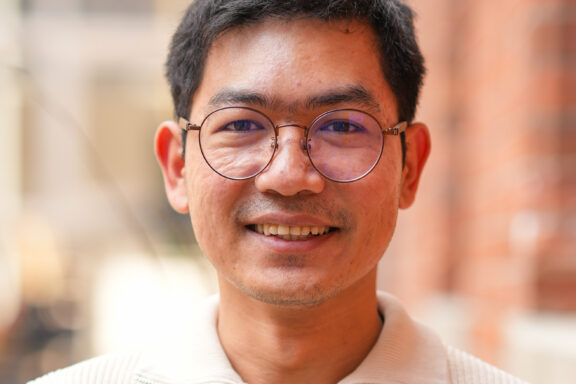
Interview with Taihei Kikuchi

Bio
Taihei Kikuchi is a Research Fellow at the Center for Southeast Asian Studies (CSEAS), Kyoto University. In 2024, he completed doctoral coursework at the Graduate School of Language and Culture, Osaka University (withdrawing with credit). His major publications include “Creation of the History of the Panglong Conference Based on the ‘National Solidarity’ Image: Myanmar Authority’s Arbitrary Reference to the Narrative by a Shan Activist: Htun Myint” (Japanese Journal of Southeast Asian Studies, Vol. 59, No. 2, 2022) and “Making Autonomy in the Federated Shan States: The Federalism of Sao Hkun Kyi (1935)” (Tea Circle, 2024).
From simple language learning to addressing compelling questions about the history of inter-ethnic relations, Research Fellow Taihei Kikuchi’s path to becoming a historian was guided by unforgettable encounters with people from Myanmar. He shares the full appeal of historical research.
──Please tell us about your research.
My specialization is the modern history of Myanmar. Specifically, I research the history of relations between the Bamar people, who inhabit the central plains, and the Shan people, who live in the mountainous basins of the east. In Myanmar, “Pyidaungsu”(ပြည်ထောင်စု or “Union”) has been upheld as a key word for national integration from before independence to the present day. However, the reality has been a case of “same bed, different dreams.” While Bamar politicians aimed for centralized integration, Shan chiefs sought to preserve their traditional authority, and Shan commoner activists sought a new era. While they all used the word “Pyidaungsu,” they each envisioned a completely different form of “nation.”
The purpose of my research is to unearth the Shan vision of “integration,” which has been buried and forgotten within Bamar-centric historical narratives. For the Shan people during the independence period (around 1947), “Pyidaungsu” was not merely a compromise; it was an aspiration for a federal union. They were desperately searching for their own way of being, using the majority-Bamar existence as a “mirror” to reflect their identity. There were two fervent desires: one was “internal federalism” to unite the scattered Shan states, and the other was “external federalism” to join hands with the Bamar people on equal footing as a united Shan entity.
From the establishment of the Federated Shan States in 1922 to the signing of the Panglong Agreement in 1947, how did the Shan grapple with their relations with the Bamar and develop their own survival strategies? Why did the earnest federalist concepts born from this struggle falter, leading to the conflict that continues to this day? My goal is to carefully untangle the complicated discourse surrounding the phrase “unity of national races” in Myanmar, examining in what contexts and how these words have been used. By unravelling each strand of history—where ideals and reality, and the intentions of the center and the periphery are complexly intertwined—I hope to see what kind of future for coexistence might lie beyond the current deadlock. Searching for those clues within the records of the past is the core of my research.
──What inspired you to pursue this path of research?
It all began in 2012, when I chose to major in Burmese at Osaka University. At that time, following the transition to civilian rule the previous year, Myanmar was in the spotlight in Japan as “Asia’s Last Frontier,” and I stepped into that world, swept up in the enthusiasm.
There was a clear turning point when simple language learning transformed into a compelling “inquiry.” As an undergraduate, I read David Crystal’s English as a Global Language[1] and Benedict Anderson’s Language and Power.[2] These works made me realize that language is not a neutral communication tool, but rather a form of power that shapes political order and social hierarchies.
When I turned this perspective toward Myanmar, I began to feel a certain discomfort. The standard Burmese I was studying so hard was, from the perspective of peripheral regions like Shan State, a language that embodied the overwhelming logic of the “center.” As long as the beautiful slogans of “Taing yin thar myar Nyi nyut yay” (တိုင်းရင်းသား ညီညွတ်ရေး or “Unity of Nationalities”) spoken at the time of independence were constructed in the language (logic) of the majority Bamar, were they not merely convenient narratives of integration for that majority? When I thought about this, I painfully realized the need to go beyond language learning and delve into the depths of history. I wanted to reexamine how this country had been formed from the perspective of the Shan people, who have used Burmese, “the language of the strong,” as a weapon, and yet have been marginalized by that language. It is precisely this ambivalence that drives me to pursue historical research.
──Could you share an episode about impressive people, things, or places you encountered in your research?
Two contrasting encounters from my research life remain strongly in my memory. The first was with Ms. M, who introduced me to my lodgings during my study abroad in Yangon. She had a network that easily crossed borders. Her father’s side was Chinese from Fujian, her mother’s side was Bamar, and her maternal Karen relatives had “piggybacked” on her strong connections to increase their mobility and expand their horizons. When she returned to Yangon from living overseas, her house would come alive with activity like a festival. A crowd of “aunties” would gather from out of nowhere, exchanging small souvenirs, updates on each other’s lives, and life wisdom.
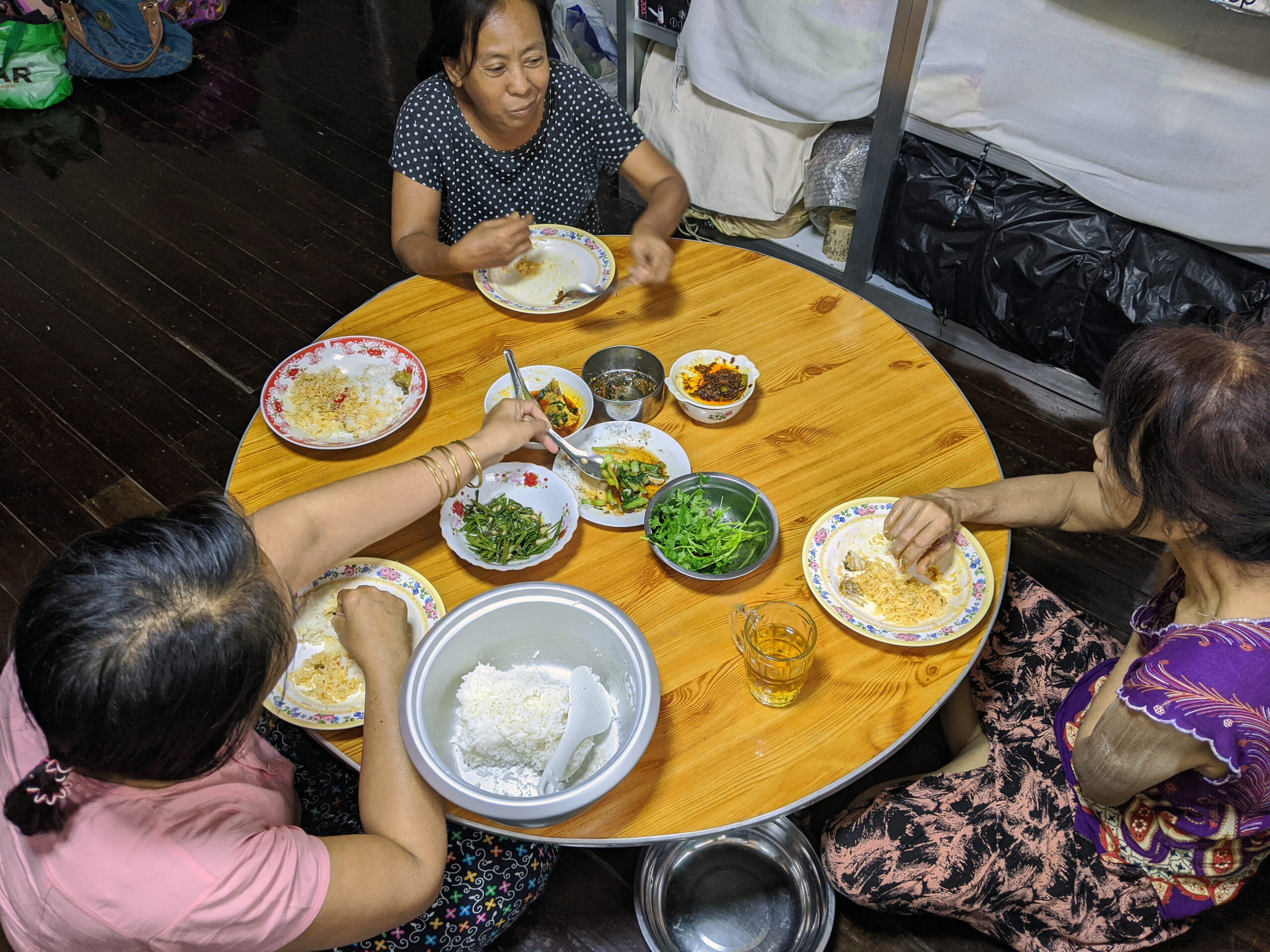
This scene, where people of different roots connected flexibly, effortlessly transcending existing ethnic and border frameworks, was the embodiment of a resilient survival strategy that would never be recorded in official records. The bustling living room and kitchen, filled with women helping each other despite their complex relations, became the starting point for my observation of Myanmar society.
The second encounter was a debate I had with a Myanmar teacher during my master’s course. We had a weekly one-on-one session to read literature and discuss. It always started with the teacher saying, “Bar ma so pyaw bar” (ဘာမဆိုပြောပါ or “Tell me anything”). We talked about everything from academics to private matters, politics, and the economy. However, once, our opinions clashed directly over the Rohingya issue. The situation in Rakhine State in western Myanmar was already deteriorating, and the trend of calling the Rohingya “Bengalis” (illegal immigrants from Bangladesh) was strengthening domestically. My teacher, to whom I was indebted, was adamant: “They are not included in the 135 indigenous national races defined by the government. Therefore, they cannot be citizens, and I cannot recognize the name Rohingya as a self-designation.”
I persisted many times in my clumsy Burmese, asking, “Can’t we think about this more flexibly?” The teacher never got angry and listened calmly, but no matter how much time we spent, the discussion always ended in a stalemate. Watching the teacher leave the room with a smile, saying, “Let’s talk again next week,” I painfully realized the immense difficulty of bridging gaps in historical perception.
The supple wisdom of life I witnessed in Yangon, and the rigid wall of historical perception I was confronted with in Japan: these two experiences taught me the multifaceted nature of Myanmar society. At the same time, they formed the basis of my current research approach: although it may seem impossible, to face people with different historical perceptions requires patient dialogue rather than seeking easy solutions.
──Please tell us about books or things that have particularly influenced you.
Victor Lieberman’s Strange Parallels[3] has had a decisive influence on my effort to connect the history of one region, Myanmar, to the broader context of world history. This book does not view the history of mainland Southeast Asia as a passive reaction to the impact of Europe on Asia, as traditionally thought, but rather as a dynamic process of indigenous development. Particularly interesting is his counterargument to the “17th-century crisis” theory, emphasized by fellow Southeast Asian historian Anthony Reid and others; Lieberman argues that in mainland Southeast Asia, a consistent process of political and cultural integration progressed from the 14th to the 19th centuries.
Lieberman explains that Southeast Asian countries like Burma, Siam, and Vietnam achieved integration as territorial states in a cycle surprisingly like that of far-off France, Russia, and Japan. His perspective, which highlights climatic and environmental factors such as global cooling after 1250 CE, prompted me to rethink human social activities within the broader framework of the natural environment. This method of positioning the Southeast Asian region as part of a synchronized Eurasian-wide surge serves as a reference for research methodology and is a source of great intellectual excitement.
──What are the difficulties and ingenuities in conducting your surveys?
The greatest difficulty in fieldwork in Myanmar is, unsurprisingly, the unstable political situation. Especially since 2021, researchers’ activities have been heavily restricted. The hurdles to overcome are countless, including access, mobility, and above all, ensuring the safety of the people who cooperate on the ground. Under these circumstances, I try to diversify my research methods while maintaining my network. In addition, during periods when I was unable to enter Myanmar, I spent time researching historical materials at the British Library in London, which houses a wealth of colonial-era records.
──What struggles or strategies do you have when compiling research results into papers or books?
The process of writing a paper is the same as walking endlessly through a long tunnel with no exit in sight. I particularly struggle with how to reconstruct fragmentary materials—huge volumes of collected documents and interview records—into a single, logical, and persuasive “story.” Shuttling between the perspectives of the Shan region and the Myanmar “nation,” and further, the perspective of the British Empire, and to portray their interactions three-dimensionally, is a process of repeatedly writing and deleting. What helps me in this arduous task is dialogue with research colleagues. By presenting my immature analyses at graduate seminars and academic conferences and receiving critical yet insightful comments, I have become aware of biases in my thinking and gaps in my logic. It is only by reflecting my research in the “mirror” of others’ perspectives that I can view it objectively. Writing a paper is a solitary task, but I keenly feel that it is not something completed alone; it stands only with the support of such an academic community.
──Could you give a comment on recommended books for young people?
I am still in the middle of my research journey and cannot preach to young people. However, if you are looking for an experience that fundamentally questions “how we view the world,” I would dare to recommend a classic masterpiece by anthropologist Edmund Leach: Political Systems of Highland Burma.[4]
Looking at the title alone, it may seem like a specialized book about the mountainous areas of northern Myanmar. However, it contains a universal “knowledge shift” that I want everyone to encounter. Leach asserts that social mechanisms and structures are not fixed things that remain unchanged once decided, but dynamic processes of constant choices and oscillations. Through his social analysis of the Kachin people living in the mountains of northern Myanmar, he depicts how people are not bound to either a “hierarchical society (Gumsa)” or an “egalitarian society (Gumlau),” but rather how their way of being changes depending on the situation. In today’s world, existing systems and rules may seem absolute. However, this book persuasively teaches us that “the world’s structures, divisions, and rules that exist before our very eyes are man-made and situational.” I hope you will take on the challenge of reading this book as a tool to question common sense and existing frameworks, and to perceive the world more flexibly.
──Please say a few words to those who intend to become researchers.
Research is a continuous series of very steady and solitary tasks. There is a saying, “Constant dripping wears away the stone”—incidentally, Burmese has this exact expression also (ကျောက်ပေါ်ရေကျပါများ၊ အပေါက်ဖြစ် / Kyauk paw yay kya pa myar, a pauk phit). A single document, a single photo, a single testimony… these are nothing more than small drops. However, I believe that if you continue to accumulate them without giving up, you will eventually open a hole in the thick wall of established theory and see a new landscape that no one has ever seen before. I look forward to meeting you someday in some field as a new colleague who shares that “single drop.”
──Please tell us about your future ambitions.
My short-term and most important goal is to publish a book based on the doctoral thesis I have been working on for many years. I want to make it a book that, without compromising academic value, conveys to general readers (not just experts) the rich history of Shan State, which has been little known until now, and the deep-rooted nature of the problems that Myanmar faces.
In the long term, as a historian, I would like to contribute in some way to resolving the challenges facing modern society. For example, in Myanmar’s peace-building process, misunderstandings of the historical background fuel conflict. I am constantly exploring how historical research can help build a foundation for dialogue among people with different positions. Furthermore, I would like to broaden my perspective to include Japan. Currently, many young people with roots in Myanmar are living in Japan, coming from diverse backgrounds. I wonder if I can help them deepen their understanding of their own roots by learning about the turbulent history and culture their parents and grandparents lived through. That is my current thought. Specifically, I would like to create a place where we can study modern and contemporary history together or launch an oral history project to record family stories. My ambition as a historian is not to store historical knowledge on a shelf as a mere record of the past, but to open it to society as a foundation for dialogue, enabling people to connect and envision a future together.
Notes
[1] Crystal, David. 1997. English as a Global Language. Cambridge: Cambridge University Press.
[2] Anderson, Benedict. 1990. Language and Power: Exploring Political Cultures in Indonesia. Cornell University Press.
[3] Lieberman, Victor. 2003. Strange Parallels: Southeast Asia in Global Context, c. 800–1830: Vol. 1 Integration on the Mainland. Cambridge: Cambridge University Press. Lieberman, Victor. 2009. Strange Parallels: Southeast Asia in Global Context, c. 800–1830: Vol. 2: Mainland Mirrors: Europe, Japan, China, South Asia, and the Islands. Cambridge: Cambridge University Press.
[4] Leach, Edmund R. 1954. Political Systems of Highland Burma: A Study of Kachin Social Structure. London: G. Bell and Sons.
This article is also available in Japanese. >>
「開かれた対話の土台としての歴史研究を目指して」
菊池泰平さんインタビュー