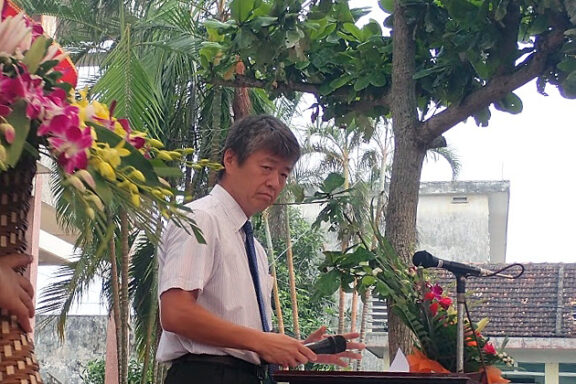
YuNing Henares (Comparative Literature, Fashion Studies)
My research focuses on women’s fashion in East Asian history. I examine how women present themselves through their dress. If dress can serve as a language to convey things verbal language is unable to, then how does the use of women’s dress reflect the complexity of twentieth-century politics? In my current project, I focus on the portrayal of Oei Hui Lan (1889–1992) in Indonesian, English, and Chinese language narratives. I am very interested in how this woman, who built up a unique “fashion language” and had a large impact on modern East Asian politics and history, is portrayed in different cultural contexts.
Daughter of the Sugar King, Wife of the First Ambassador
Oei Hui Lan was the second daughter of Oei Tiong Ham, a Chinese emigrant in Dutch Indonesia who was known as the sugar king. Among Oei Tiong Ham’s children, Hui Lan was the most well-known, not only because of her background but also because of her cross-continental journey. Growing up in Semarang, she was fortunate enough to be educated by European teachers hired by her father from the United Kingdom and France. Hui Lan was raised as an upper-class young woman. This paved the way for her appearance in fashion magazines later in her life. Although her first marriage with British consular agent Beauchamp Forde Gordon Caulfield-Stoker eventually ended in divorce in 1920, this did not impact young Hui Lan’s bright future, due to the fact that in the United Kingdom in the 1920s, divorce was more acceptable to the public than it had been previously. Her second marriage to the first diplomat in modern China, Wellington Koo, introduced her glamorous sartorial style to various countries across the world. As an ambassador’s wife, Hui Lan appeared in public on many occasions. She was skilled at mixing oriental and Western elements in her dressing style, making her noticeable among the members of the European upper class. Her images were captured in Indonesia, the United Kingdom, France, China, and the United States, in forms of media that crossed the boundaries of language and culture. If fashion is also a language, then Hui Lan was apparently one of its masters.
As the wife of the first diplomat in modern China, Hui Lan witnessed the fast-changing and complex political situation in modern China. For a brief time, she was even the first lady of the Republic of China for a short time. However, some turning points of her life were 1941, when she moved to New York City, and 1956, when she underwent a divorce from Wellington Koo. She lived the rest of her life in New York and always claimed that she was the authentic Mrs. Koo, although Wellington Koo later married another Chinese woman, Juliana Young, who had been Koo’s mistress in the 1930s.
Hui Lan’s Voice and Portrayals

https://commons.wikimedia.org/wiki/File:Oei_Hui-lan_portrait_painting.jpg
One thing I find very interesting in this project is looking at how Hui Lan talks about herself and at how other writers portray her. It seems that writers and readers in different cultures hold different kinds of background knowledge and thus want to know about different aspects of her life.
Hui Lan published two autobiographies in English. The first one, Hui-Lan Koo, Madame Wellington Koo: An Autobiography, was released in 1943. The second one came to press in 1975 and contains more stories about her own life. Hui Lan spent more than 50 years in the United States, much longer than any other place in which she had lived. Therefore, most of her first-person narrative was released in English. She left behind many images of herself in glamorous dresses in English-language media, such as the fashion magazine Vogue. This brought the English-speaking world abundant opportunities to be fascinated by her unique fashion style, a mix of the East and West. Although she reflected a lot on her long life in her autobiographies, she apparently wanted her readers to remember her as a young lady who was active in British upper-class society in the 1920s, like an oil painting of her done by British artist Charles Julian Theodore Tharp (1878–1951) in 1921. On the other hand, it was also in 1943 that British Vogue had a portrait of her in a well-made Chinese dress (Qipao), with embroidery of dragons on it.
So far, I have found three biographies of Hui Lan in Indonesian, published in 2009, 2011, and 2017. Two of them were done by the same author/translator. This suggests that the publishers were interested in revisiting her story. Going deeper into the texts, it seems that the Indonesian biographies place more emphasis on her link with her wealthy father and his huge family. Moreover, the visual design of the Indonesian-language book covers darkened the image of Hui Lan, and this conveys a sense of sorrow. Perhaps the Indonesian publishers wanted their readers to view her life as a tragedy.
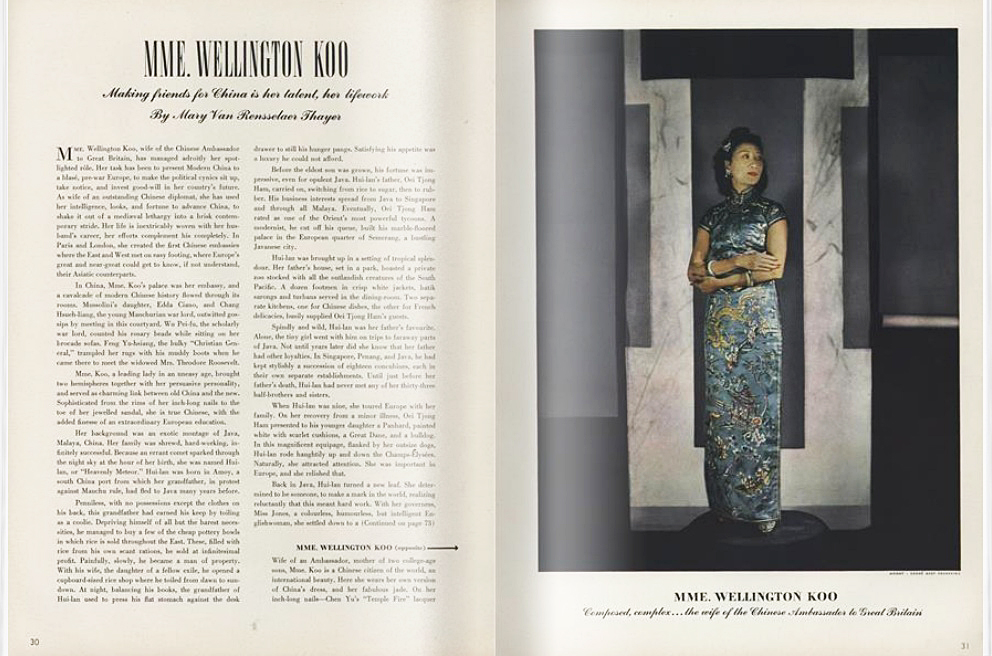
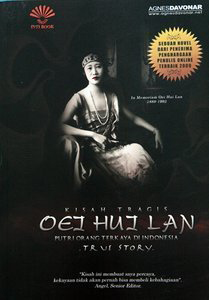
Books and essays on Hui Lan in the Chinese language, including both traditional and simplified Chinese, were translated from her English autobiographies. However, the Chinese-language world carries a more complicated image of Hui Lan. Her marriage to Wellington Koo connected her with wartime Chinese politics and important politicians in the 1930s, such as Chiang Kai-Shek and his wife, Soong Mei-ling. Hui Lan is thus well-known in the Chinese-speaking world due to her ties with the political world. Hui Lan, like other wives of political figures, used her Chinese dress as a form of communication with the media. The sartorial styles of Chinese politicians’ wives, therefore, became a hot topic among the people. Their tastes, their luxuries, and their persistence in maintaining certain styles brought with them a number of juicy details for readers.
Lastly, the most recent book dealing with Hui Lan was As Equals: The Oei Women of Java, by Malaysian writer Daryl Yeap. This book centers on the Oei family in the late nineteenth century, allowing readers to see the background of Hui Lan’s family tree and the complexities of her life as a Chinese Indonesian under Dutch colonialism. Under Yeap’s investigation, Hui Lan’s image as a daughter comes to reflect multicultural influences from both Western and East Asian cultures. This brings the narrative on Hui Lan back to Southeast Asia, where her life began.
Madame Wellington Koo or Oei Hui Lan?
My first encounter with Hui Lan’s story occurred when I was maybe thirteen. I was reading an essay in a magazine while waiting at a dental clinic. The essay was about Hui Lan’s husband’s journey to Europe, but there were a few pages about Hui Lan that focused not on her marriage but on her wealthy background and luxurious life. I guess I remembered Hui Lan’s name because her upper-class life seemed very attractive to me as a young girl: necklaces, gardens, and parties. Over the years, I saw Hui Lan’s name here and there, sometimes in research papers, sometimes in general essays. While much of East Asia and Southeast Asia were suffering from the effects of the Second World War, Hui Lan enjoyed a life that seemed to be impacted very little by the war. I came to realize that, in the same way that we come to follow celebrities’ accounts on social media, readers across generations, languages, and cultures came to share an interest in Hui Lan’s life.
Working on this project brought me to see how Hui Lan identified herself and how Hui Lan was identified in different cultural contexts. It is striking that although she was sometimes more influential than her husband in a social or cultural sense, society only saw her as the wife of Wellington Koo. Indeed, as the wife of a diplomat in the 1920s, she came to be associated with her husband and his title. In English, her last name was changed from Oei to Koo. This was the case in her first autobiography, which was entitled Hui Lan Koo. In contrast, the Chinese and Indonesian versions keep her original last name Oei, which suggests her tie with her biological family continues.
Conclusion
At CSEAS, I collect and examine biographies and sources about Hui Lan published in English, Indonesian, and Mandarin. Scholars I have met here have generously shared with me their knowledge about Hui Lan, and I really appreciate that. Some of them had their first impressions of Hui Lan through portrayals of her in paintings in various places around the world. Therefore, I think that in addition to examining written documents on Hui Lan, it would also be helpful for my project to explore portrayals of Hui Lan from the perspective of visual culture or art history.
This article is also available in Japanese. >>
「黃蕙蘭の伝記を読む」(ヘナレス ユーニン)