
Youdiil Ophinni (Medicine, Area Genomics)
What is a scientist to do upon realizing their life’s work—their research, thought, and passion—has become complicit in a system they no longer recognize, or …

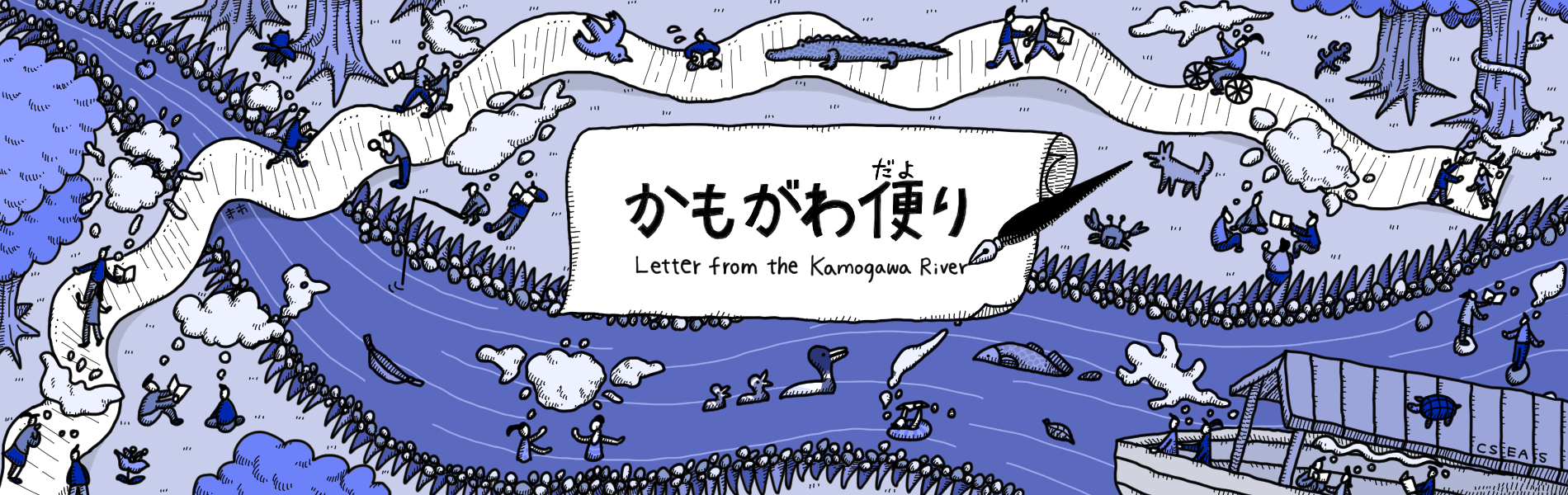
Illustration by Atelier Epocha

Taihei Kikuchi (Area Studies, Burmese History)
Heading east along Shijo-dori, the heart of Kyoto’s vibrant downtown, one passes the Kamo River and approaches the famous Yasaka …

Mario Lopez (Anthropology)
Last year, I took a short sabbatical leave, which gave me a rare opportunity to hit the pause button to rediscover the virtue of idleness. I returned to my home country, the U.K. and …

Shinya Takeda (Forest Science)
In high school, whenever I grew tired of studying for university entrance exams, I invariably reached for an exploration travelogue. I experienced the grueling trek across Antarctica through …

Yalei Zhai (Development Economics, Area Studies)
Last month, I welcomed several overseas scholars to a seminar at CSEAS. Among them was a couple who arrived with their four-year-old child. …

Hiroshi Ishii (Maritime archaeology, Modern conflict archaeology)
The first time I heard the term “Underwater Archaeology” was in the middle of a desert. During a field school in the high desert of Oregon, …

Julie Ann de los Reyes (Geography, Political Ecology)
My home country, the Philippines, is no stranger to storms. Each year, an average of 20 tropical cyclones sweep across the archipelago, a fact so routine that typhoons have become part of the rhythm of life—anticipated, endured, and, with luck, survived. But in September 2009, …

Hiroyuki Yamamoto (Area Studies, Media Studies)
Ever since childhood, I have loved the Ultraman television series that features the Ultra superheroes. I vividly recall a scene
…

Caroline S. Hau (Cultural Studies)
In my childhood during the 1970s, two-wheeled, horse-drawn carriages called kalesas were ubiquitous in Manila’s Chinatown. They brought denizens to and from school, the movie house, restaurant, clinic, store, church, and temple. Their cousin, the spacious karitela, transported goods in bulk from the markets of …